 |
| Where is the Friends video of this armoring project on Blakely? |
Showing posts with label SMP. Show all posts
Showing posts with label SMP. Show all posts
Friday, January 29, 2016
Cranking Up the SMP PR Machine
It's wonderful that we have an independent, critical thinking press. We have Orcas Issues. We have the Journal too. And we have the Friends.
Monday, November 30, 2015
Shoreline Master Plan Update
This post comes to us by way of Merri Ann Simonson of Caldwell Banker in Friday Harbor.
As you may be aware, the Critical Areas Ordinance (CAO) went into effect in March 2014. The Shoreline Master Program (SMP) has been in the update process for the last few years and is currently out for public comment until December 8, 2015. Then it will be sent on to the Department of Ecology for their comments and then back to our County for final revisions.
The Council is holding continued public hearings on December 2, 3 and 4th this week in Friday Harbor. They'll take comments on Lopez December 1st and on Orcas on December 8th.
It is expected that the SMP may be in effect as early as spring of 2016. Many of the proposed regulations as contained in the SMP were established in the CAO or at least precedence set.
It appears that the non-conforming regulation currently in effect under the WAC will be updated in the SMP. The existing formula that regulates how much you can increase the size of an existing non-conforming home on the waterfront or near a wetland is not included in the proposed SMP. In my opinion, the draft SMP language to address a non-conforming home remodel is more discretionary on the part of the Planners during their decision process.
The proposed language is more relaxed as there appears to be no limit on the size that the non-conforming home can be increased. However, you must propose mitigation measures to address any potential negative impacts to the critical areas. This requirement will have to be met by retaining professionals to prepare reports acceptable to the County
A legally non-conforming structure is defined as one that is out of compliance with the current regulations, but was in conformance at the time of its construction. For example, a home that is 35 feet from the shoreline versus the current setback as required by the CAO, is considered a non-conforming structure.
In order to expand an existing non-conforming structure under the current regulation and formula, you will need to obtain a building permit prior to the effective date of the SMP. A Residential Pre Approval is not binding and will not survive a regulation change.
If you are the owner of a non-conforming structure and are contemplating a remodel or expansion, you should review the existing regulation as well as proposed. I have attached links below; one to the current non-conforming regulation and one to the PROPOSED language in the SMP. If you believe that the proposed regulation will be more difficult to comply with than the existing, I would not delay your application for a permit.
CLICK HERE TO VIEW EXISTING WAC FOR NON-CONFORMING CONSTRUCTION
CLICK HERE TO VIEW PROPOSED SMP LANGUAGE
CLICK HERE TO VIEW THE COUNTY WEBSITE FOR ENTIRE SMP
As you may be aware, the Critical Areas Ordinance (CAO) went into effect in March 2014. The Shoreline Master Program (SMP) has been in the update process for the last few years and is currently out for public comment until December 8, 2015. Then it will be sent on to the Department of Ecology for their comments and then back to our County for final revisions.
The Council is holding continued public hearings on December 2, 3 and 4th this week in Friday Harbor. They'll take comments on Lopez December 1st and on Orcas on December 8th.
It is expected that the SMP may be in effect as early as spring of 2016. Many of the proposed regulations as contained in the SMP were established in the CAO or at least precedence set.
It appears that the non-conforming regulation currently in effect under the WAC will be updated in the SMP. The existing formula that regulates how much you can increase the size of an existing non-conforming home on the waterfront or near a wetland is not included in the proposed SMP. In my opinion, the draft SMP language to address a non-conforming home remodel is more discretionary on the part of the Planners during their decision process.
The proposed language is more relaxed as there appears to be no limit on the size that the non-conforming home can be increased. However, you must propose mitigation measures to address any potential negative impacts to the critical areas. This requirement will have to be met by retaining professionals to prepare reports acceptable to the County
A legally non-conforming structure is defined as one that is out of compliance with the current regulations, but was in conformance at the time of its construction. For example, a home that is 35 feet from the shoreline versus the current setback as required by the CAO, is considered a non-conforming structure.
In order to expand an existing non-conforming structure under the current regulation and formula, you will need to obtain a building permit prior to the effective date of the SMP. A Residential Pre Approval is not binding and will not survive a regulation change.
If you are the owner of a non-conforming structure and are contemplating a remodel or expansion, you should review the existing regulation as well as proposed. I have attached links below; one to the current non-conforming regulation and one to the PROPOSED language in the SMP. If you believe that the proposed regulation will be more difficult to comply with than the existing, I would not delay your application for a permit.
CLICK HERE TO VIEW EXISTING WAC FOR NON-CONFORMING CONSTRUCTION
CLICK HERE TO VIEW PROPOSED SMP LANGUAGE
CLICK HERE TO VIEW THE COUNTY WEBSITE FOR ENTIRE SMP
Sunday, February 23, 2014
Uncertainty In the Department of Stone-Age Ecology
About a month ago, Hiroo Onoda died at the age of 91. He was a Japanese WW II holdout soldier who didn't surrender until long after the war was over. For 29 years, he lived on an island in the Philippines with other holdouts, dismissing all evidence (including messages sent to them) that the war was over. They lived by eating what they could find in the jungle or steal from local Filipino farmers. After losing all his fellow holdouts to various circumstances, Onoda was finally persuaded to give up in 1974.
Also, we occasionally still hear press reports about Stone-Age tribes that hold out against the modern world ... in the Amazon ... Papua New Guinea ... or some remote island. In these days of iPads, space stations, and genetic engineering, some of these Stone-Age tribes don't even know how to make fire ... and have never heard of the wheel.
Which brings us to the Shorelands and Environmental Assistance Program within the Department of Ecology. These are the regulators who advise local governments about shorelines and wetlands because of the Shoreline Management Act (SMA) and the Growth Management Act (GMA). In reality, the responsibilities of Ecology are very different under these two Acts, but they don't want you to know that. Under the SMA, Ecology is directly authorized to oversee, and take charge if necessary, of land use planning for shoreline zones. Under the GMA, they have no authority. No one says this better than Gordon White, the Head of the Shorelands and Environmental Assistance Program:
Also, we occasionally still hear press reports about Stone-Age tribes that hold out against the modern world ... in the Amazon ... Papua New Guinea ... or some remote island. In these days of iPads, space stations, and genetic engineering, some of these Stone-Age tribes don't even know how to make fire ... and have never heard of the wheel.
Which brings us to the Shorelands and Environmental Assistance Program within the Department of Ecology. These are the regulators who advise local governments about shorelines and wetlands because of the Shoreline Management Act (SMA) and the Growth Management Act (GMA). In reality, the responsibilities of Ecology are very different under these two Acts, but they don't want you to know that. Under the SMA, Ecology is directly authorized to oversee, and take charge if necessary, of land use planning for shoreline zones. Under the GMA, they have no authority. No one says this better than Gordon White, the Head of the Shorelands and Environmental Assistance Program:
"We don’t have regulatory authority in local critical areas ordinance issues. We don’t make rulings or issue enforcement actions under local critical areas ordinances. Those tasks are on local government turf" (Gordon White, Eco-Connect Blog, February 14, 2012.)Let's be clear about this. Under the SMA, Ecology is authorized to carry out the limited objectives of the SMA only, which is a planning law, not an environmental protection law per se. Under the GMA, Ecology is not authorized for anything, except to advise the Department of Commerce about Critical Areas. That bears repeating ... they are authorized to advise the Department of Commerce (not local Counties) about critical areas (not about the 14 goals or any other aspect of the GMA). Ecology would like you to believe that they are in charge of habitat and endangered species and wetland delineation and saving the planet and the whole GMA. They would like you to believe they are authorized to mainline their biased GMA advice directly into the veins of buffer-addicts in every County Planning Departments ... but they are not.
Altogether different from the SMA and GMA, Ecology is separately authorized under the Clean Water Act (CWA) to regulate discharges to waters of the State/US, but their authority under the CWA is about discharges. They regulate pollution, not non-pollution. They regulate effluent, not waters. Nowhere, outside of the specific planning purposes of the SMA, is Ecology given authority to identify or delineate streams, wetlands, shorelines, or any other waters of the State/US. They have proclaimed themselves as the expert authorities in this area, but they are not.
This brings us back to our Stone-Age lead-in. The Ecology folks who aren't authorized for much of anything produce Best Available Science (BAS) about everything. However, like the Stone-Age tribes who haven't heard of the wheel, the Cro-Magnons at the Shorelands and Environmental Assistance Program seem to be entirely ignorant of concepts accepted everywhere else in environmental science. As we repeatedly mention, they know nothing about risk assessment, but they also know nothing about environmental chemistry ... or geology ... or habitat ... or hydrology ... or physics ... or bio-statistics ... system dynamics ... or science generally. They say revealingly stupid things like (from the Hruby report), "The recent research has also increased our understanding of the many different factors that control the effectiveness of a buffer at trapping pollutants" such as type of pollutant, concentration of pollutant etc.
Increased "our" understanding? How could you not know this? This is in every elementary textbook (and there are thousands) dealing with risk assessment, fate and transport, and environmental chemistry. These principles are at work daily in Ecology's own Toxics Program. This is like a Stone-Age tribesman in the 21st century saying that "we" just discovered fire, and then bombastically posturing as if they are on the cutting edge of discovery. Somehow, and I don't know how, the Shorelands and Environmental Assistance Program has been able to survive like a lost Stone-Age tribe, surrounded by modern technology, but unaware of it. Along with them are fellow holdouts comprised of planners, consultants, attorneys, and non-profits who profit from believing the earth is flat.
We have to contend with their ignorance and bias in maddening ways, one of which was mentioned by some commenters to the previous post ... namely scientific uncertainty and the application of the precautionary principle. One of the ways Ecology projects their power and Stone-Age ignorance is by practicing data sophistry. For instance, we actually have quite a bit of data in these islands that show that we have no problem. Cleverly, though, that gets twisted by Ecology and the County into an opportunity to apply the precautionary principle. Let's discuss an example for the sake of illustration. If I were to sample a stream for pollutants, and if the results were to come back as non-detects, that is positive evidence of no problem. We have lots of data like that here in the islands ... after taking into account data quality, we have positive evidence of no problem. The evidence for "no problem" is in the form of zeros (non-detects) but that's not "no data" and it isn't "uncertainty." It's just that we found nothing because nothing is there.
Finding positive evidence of nothing, however, gets transmogrified into "we have no data" or "we don't know" or "it's pristine" or "the results are inconclusive" or "we're uncertain" ... and before you know it, the precautionary principle gets invoked, and we get 300-foot buffers in rural areas and 50-foot buffers in urban ones. That's how that happens. The absence of a problem and lots of "zero data" gets manufactured into uncertainty requiring the greatest amount of precaution and the toughest land use restrictions. The cleanest areas get "protected" in the most severe way when any rational analysis would have deployed greater "protection" for the riskier exposure scenario. We have to put a stop to that BAS ackwards outcome by pointing out what the data are really saying.
Saturday, November 30, 2013
FONSI Disconnect
Back in October, we mentioned that the National Monument had hard-armored part of a primo pocket-beach on Lopez ... Watmough Bay, and not even the insiders who had sat in Secretary Salazar's office to hatch the National Monument scheme knew about it ahead of time. No structures were at risk at Watmough Bay. Moreover, the shoreline consultant used by the Friends to oppose nearly every shoreline activity proposed by private homeowners in San Juan County -- Coastal Geologic Services -- performed some of the work and design. Before proceeding with the construction, the Bureau of Land Management conducted an Environmental Assessment of the shoreline stabilization and reached a "Finding of No Significant Impact" or FONSI. They also conducted an EA for trail-related site work that resulted in another FONSI.
This shoreline stabilization work is exactly the kind of project that would have been opposed by the Friends (and Coastal Geologic Services) if a private homeowner had tried to do it. There would have been howls about impacts. We have reached a state of affairs in our county where it is easier to do shoreline projects inside the National Monument than outside. On top of that, via the SMP, the county then imposes buffers on all National Monument shorelines whether they are armored or not.


This shoreline stabilization work is exactly the kind of project that would have been opposed by the Friends (and Coastal Geologic Services) if a private homeowner had tried to do it. There would have been howls about impacts. We have reached a state of affairs in our county where it is easier to do shoreline projects inside the National Monument than outside. On top of that, via the SMP, the county then imposes buffers on all National Monument shorelines whether they are armored or not.


Wednesday, May 22, 2013
Shireene Hale's Pattern Of Behavior
Yesterday, the Council selected Michael Thomas as the new County Manager. Thomas is from King County and has a planning background. Mr. Thomas, you have your work cut out for you because our Planning Department functions like a rogue government within a government, with a functional head who openly despises public participation and dissent.
In the email below (from a year ago), Hale discusses her reaction to a CAO public meeting that was, from our perspective, one of the greatest meetings from a public participation standpoint. It was one of the worst from the standpoint of the reaction of public officials.
Once again, Shireene Hale thinks dissent is violence. Someone who regularly cannot tell the difference between dissent and violence may not be stable enough to deal with the public, and perhaps we should be concerned about her reactionary behavior or the irrational steps she might take.
Who is the threat here? It makes me wonder whether Hale will start coming to meetings armed and dangerous. In more ways than one, we need protection from Hale.
In the email below (from a year ago), Hale discusses her reaction to a CAO public meeting that was, from our perspective, one of the greatest meetings from a public participation standpoint. It was one of the worst from the standpoint of the reaction of public officials.
Once again, Shireene Hale thinks dissent is violence. Someone who regularly cannot tell the difference between dissent and violence may not be stable enough to deal with the public, and perhaps we should be concerned about her reactionary behavior or the irrational steps she might take.
Who is the threat here? It makes me wonder whether Hale will start coming to meetings armed and dangerous. In more ways than one, we need protection from Hale.
From: Shireene Hale [mailto:shireeneh@sanjuanco.com]
Sent: Tuesday, April 10, 2012 11:54 AM
To: Colin Maycock; Jon Cain; Lovel Pratt; Patty Miller; Pete Rose; Randall Gaylord; Rene Beliveau; Richard Fralick; Shireene Hale
Subject: Agenda for Monday CAO Implementation Team meeting?
Sent: Tuesday, April 10, 2012 11:54 AM
To: Colin Maycock; Jon Cain; Lovel Pratt; Patty Miller; Pete Rose; Randall Gaylord; Rene Beliveau; Richard Fralick; Shireene Hale
Subject: Agenda for Monday CAO Implementation Team meeting?
Good morning,
What do you all have for agenda items for the Monday CAO/SMP Implementation team meeting? Colin will not be attending as he will be in Costa Rica.
At this point I have two items:
* Conduct of public meetings on CAO and SMP.
* Alternatives for getting the wetland and fish and wildlife regulations through the approval process.
Conduct of Public Meetings
On the conduct of public meetings, I would like to discuss options for ensuring that our citizens, staff, consultants, Council and Planning Commissioners do not feel threatened or intimidated, and to ensure that comments are focused on the issues, and not on blaming or attacking individuals. Problem meetings in the past few months include the last three Planning Commission meetings (particularly the March 6 meeting), the San Juan town hall meetings, and the Orcas SMP meeting.
For those that have not heard, we are aware of two separate instances of people discussing the use of guns. One was a warning from someone that works at the Orcas fire station, the other was a conversation overhead on the ferry. Chances are nothing will happen, but given the way John Evans and others are stirring up fear, hatred and hostility, and given some of the testimony we heard on March 6, I don't think the possibility of violence should be dismissed.
In addition, prior to the March 16 Planning Commission meeting, Gordy Peterson suggested to Janice that she should consider calling in sick rather than attend the meeting, because "it was going to be ugly". This may constitute intimidation of a public servant under RCW 9A.76.180 and 9A.04.110. Given everything that is going on, it was intimidating to those of us charged with running the meeting.
Alternatives to help with the public meetings include:
* A clear statement from our leaders (Patty and/or the full Council ?) assuring people that we will get through this and that their comments are being considered. Other topics that could be touched on include reassuring people that if their house burns down, they will be able to replace it; that we are doing are best to keep costs down; that we are trying to find the least intrusive approach that will pass muster with the Growth Board; that what we are trying to develop is a moderate approach that is more fair and tied to the current science than the Ecology recommended regulations; that we are all friends and neighbors, and though we may disagree it is important to be civil and respectful of one another so that all points of view can be heard, and so that people don't feel intimidated; that we will try to find the resources to refine
the wetland map so that is does not show man made ponds that are not wetlands; and encourage people to read the proposals for themselves, rather than believing what others are telling them.
the wetland map so that is does not show man made ponds that are not wetlands; and encourage people to read the proposals for themselves, rather than believing what others are telling them.
* Do what we can to get through the rest of the process in as efficient a manner as possible, to remove the anxiety associated with uncertainty.
* Consider holding a joint PC/ CC hearing on the fish and wildlife amendments, to provide the staff and Planning Commission, and particularly the Planning Commission chair, with some additional support, and to help move the amendments along through the process.
* Hold all meetings in the Council chambers so that they can be live streamed. If F&W is a joint hearing with the Council, perhaps testimony could be taken from the Orcas and Lopez libraries (we don't have the capacity to do it without assistance and another staff person).
* Consider having a deputy present for the hearings/ meetings. We have been trying to avoid this - but it may be time to give it serious consideration.
* Consider developing clear expectations of conduct, enforced by the chair, and let everyone know what they are and what will happen if they are not followed. I suggest that clapping, jeering, cheering, and statements that are focused on individuals rather than issues not be tolerated. Options include asking individuals to leave, and if the Planning Commission/ Council are in deliberations (testimony is not being accepted), if necessary the room can be cleared so that deliberations can continue without the disruptions.
Adoption Process for Wetlands and Fish and Wildlife Amendments
Regarding the approach for getting through the remainder of the process, following is a schedule I sent to Patty yesterday.
Wetland Amendments
April 23 - Signed PC draft of wetland amendments and staff report submitted to Council.
May 1 - First touch to review PC recommended draft, findings and recommendations (including the recommendation for a conference call between the Council, Dr. Adamus and Dr. Mayer, to discuss whether we are properly applying Mayer et al. 2007, and to consider using a paper by Xuyang Zhang et al. (2010) as a guide to buffer width, rather than Mayer
et al.)
et al.)
May 7 - field trip (may be just wetlands - if we can get the F&W draft out prior to then, could be both wetlands and F&W).
May 9 - publish hearing notice
May 21 or 22 - CC hearing on wetlands (half day?)
??? - deliberations (probably need a full day)
F&W Amendments
Prior to June 20 - release hearing draft and publish notice.
July 9 or 10 - Joint PC/CC hearing, with PC deliberations in July, followed by CC deliberations. If necessary CC can hold another hearing on another draft prior to consistency review. (Note: I am out of town on vacation June 18 through July 4).
Note: Having a joint hearing does a couple of things. This is likely to be a difficult hearing and it provides the Planning Commission and CD&P staff some support that they don't normally have. It also helps us get through the steps in a more efficient manner.
Please let me know if you have additional items for discussion.
Shireene
Monday, May 6, 2013
Taking Stock
The election results should be certified this week. The final count is later today. With just a handful of ballots remaining, the totals as of May 1 are:
- Pratt - 3,359 to Jarman - 3,421
- Byers - 3,356 to Hughes - 3,485
- McClerren - 2,783 to Stephens - 3,701
Combining these figures with the PDC totals, fundraising-per-vote amounted to the following (with Trust Islanders fundraising spread evenly across Jarman, Hughes, and McClerren).
- Byers - $9.12 per vote
- Jarman - $7.74 per vote ($5.41 per vote without Trust Islanders)
- Pratt - $6.96 per vote
- Hughes - $5.87 per vote ($3.58 per vote without Trust Islanders)
- McClerren - $5.51 per vote ($2.68 per vote without Trust Islanders)
- Stephens - $5.24 per vote
The elections may be over, but there is still plenty of controversy in our islands. Many of our fellow citizens continue to push for greater regulation, even if they don't follow the rules themselves. Also, the Pictometry mess is raising important questions about privacy, and the Friends and their friends (e.g., Futurewise) are gearing up for battle about the Shoreline Management Plan (SMP) update.
More to come in future posts on all that ... and more.
The better approach would be to prevent construction of new homes where they will ever need armoring and then prohibit the construction of armoring for that home. Once shoreline erosion reaches the home, it must either be removed from the shore, or rebuilt further upland.
And in response to the argument that preservation of aesthetically stunning landscapes is elitist, I would argue that transferring the benefits of natural views of the shoreline from the public to wealthy, shoreline property owners is rather elitist.
For those passing by water, all the homes may be considered visual blight.
-- Stephanie Buffum (8/13/09) Executive Director, Friends of the San Juans
Monday, April 29, 2013
We Don't Need No Stinkin' Privacy
TH readers have made a lot of good comments about privacy and the whole Pictometry fiasco. We thought it would be a good time to review where we stand on a variety of privacy fronts.
In short, the Trojan Heron believes government should be transparent and public. On the other hand, we believe that citizens are entitled to privacy, especially when in their own home and on their own property.
On the bright side, we are pleased to receive word that House Bill 1128 died last month. This was the Bill that sought to weaken the Public Records Act by allowing public agencies to use the courts to block requesters and to limit the time spent compiling records. The demise of this Bill is a win for everyone who believes in transparent government.
On the Pictometry front, from the April 23 report from Stan Matthews to Council:
In short, the Trojan Heron believes government should be transparent and public. On the other hand, we believe that citizens are entitled to privacy, especially when in their own home and on their own property.
On the bright side, we are pleased to receive word that House Bill 1128 died last month. This was the Bill that sought to weaken the Public Records Act by allowing public agencies to use the courts to block requesters and to limit the time spent compiling records. The demise of this Bill is a win for everyone who believes in transparent government.
On the Pictometry front, from the April 23 report from Stan Matthews to Council:
Pictometry is currently flying Whatcom and Skagit Counties. The exact date of the flights here depends on weather.Weather reports for the rest of this week are good for flying, so it would appear that the data is being collected. Apparently, San Juan County can turn down the data once it's collected and therefore not have to pay; however, the data would have already been collected, and presumably, Pictometry could then turn around and sell it to someone else. In fact, there are companies who will provide aerial photos to municipalities for free in return for a cut of the enforcement fees collected as a result.
If the planners and GIS people had their way, we'd probably have live cameras in the sky evaluating us on a constant basis. We think that it's time that the County developed a technology policy and a separate privacy policy to ensure that we only consider island-appropriate and island-affordable technologies necessary for planning and science ... not enforcement. When the use of aerial photos shifts from a "planning or scientific purpose" to an "enforcement purpose," then we have crossed the line into a surveillance program, whether drones are used or not.
There is an attitude held by some in government that if we aren't hiding anything, then there is nothing to be concerned about from the latest high-tech aerial photos. That's a specious argument. We have blinds and shades despite having nothing to hide inside our homes. We close the bathroom door even though nothing secret happens in there. Privacy is a basic human need without connection to wrongdoing.
In fact, whenever someone advances the "if you have nothing to hide" argument, it is a dead giveaway that the speaker is simply wanting to nab people with the new technology.
Why is it that some in our County government (see clip below) think secret government meetings are a valuable part of the deliberative process, and yet these same people fail to recognize the need for personal privacy protections?
Note: we apologize for the A/V sync issues but they are on the original video from the County.
Note: we apologize for the A/V sync issues but they are on the original video from the County.
Sunday, April 28, 2013
Speaking For The Fish
Despite the continuing mayhem about the CAOs, this year is likely to be dominated by shoreline discussions related to the Shoreline Management Plan (SMP) update. From CAO testimony, we have already had a prologue of what these discussions might look like.
Watch the clips below to hear Barbara Rosenkotter of the County (and formerly of the Byers campaign) speak for the fish. Then watch Jim Slocomb speak on behalf of the Marine Resources Committee (MRC) in recommending that all shorelines be considered critical ... essentially because fish need water and fish might use any of the marine water in the county at some point or other. The Rosenkotter/Slocomb view is that "protection" means that every inch of shoreline in our county has to be designated as critical.
This raises a major question that our County government has yet to wrap its head around. Are we protecting "areas of use" or "areas needed for population viability?" The CAOs say we are required to protect population viability.
But that isn't the view of the Salmon Recovery Lead Entity or the MRC in these video clips.
Note: we apologize for the A/V sync issues but they are on the original video from the County.
Watch the clips below to hear Barbara Rosenkotter of the County (and formerly of the Byers campaign) speak for the fish. Then watch Jim Slocomb speak on behalf of the Marine Resources Committee (MRC) in recommending that all shorelines be considered critical ... essentially because fish need water and fish might use any of the marine water in the county at some point or other. The Rosenkotter/Slocomb view is that "protection" means that every inch of shoreline in our county has to be designated as critical.
This raises a major question that our County government has yet to wrap its head around. Are we protecting "areas of use" or "areas needed for population viability?" The CAOs say we are required to protect population viability.
But that isn't the view of the Salmon Recovery Lead Entity or the MRC in these video clips.
Note: we apologize for the A/V sync issues but they are on the original video from the County.
Thursday, March 21, 2013
Pratt Notes Involved In Deposition
Commenters have asked to see the notes related to Lovel Pratt's deposition in the secret-meeting CAO-Committee OPMA lawsuit. They are provided as images below (click any of the images below to enlarge). They'll be the subject of a future post, but for now, have a look and judge for yourself if Pratt and the rest of the Committee discussed only non-substantive scheduling matters.
Oh, and by the way, the BLM lands are now a National Monument too (another link here).
_______________________________________________________________


Oh, and by the way, the BLM lands are now a National Monument too (another link here).
_______________________________________________________________


Tuesday, January 15, 2013
Are You Aware That Your Awareness Has Been Targeted?
Some stories of government-gone-wild in these islands are hard to explain because the layers of bureaucracy and incestuous connection (in a bureaucratic sense) are so tediously complicated. To that point, over the next few postings, we will try to reveal some bite-size chunks of the bizarreness associated with something called the Stewardship Network.
For a starting point about the Stewardship Network, let's first take a look at the San Juan County ECONet. ECONet stands for the Education, Communication, and Outreach Network. It's part of the Puget Sound Partnership (PSP). San Juan County has its own local ECONet, and every local ECONet (there are 12 of them) has a local coordinator funded by a grant from the PSP.
The San Juan County ECONet used to be headed by Jeff Hanson (email below), and it is now headed by Karrie Cooper. Hanson is the former Outreach Coordinator for the Marine Resources Committee (MRC), and Karrie Cooper has been associated with the Kayak Education and Leadership Program (KELP). You with me so far?
As mentioned, the ECONet gets grant money from the PSP and elsewhere. Grant money to the ECONet supports the Good Steward Awards, Sustainable San Juans events, and the website for the Stewardship Network. When you are looking at those entities/activities, you are looking at three different facets of the same organization: the San Juan County ECONet. Anyone can belong to the ECONet, as long as they buy into ECONet mission (some would say "agenda"). For example, the Friends proudly boast they are part of the San Juan County ECONet steering committee (it's listed on their "Accomplishments" webpage), and ECONet meetings are sometimes held at the Friends' offices.
During the CAO/SMP process, many of us have become frustrated at times because the Friends and their friends seem to say that our waters are in trouble regardless what the local data might say. Some of us have wondered aloud whether the Friends are getting paid to say that no matter what.
It turns out that may be exactly what has been going on. Through a program called "Targeted Awareness Grants" (TAGs), money is being given to the local ECONets to promote the view that Puget Sound is in trouble. It's easy money. All the grant awardees have to do is commit to spread the pre-arranged message of gloom about Puget Sound. Below is an email from the ECONet Coordinator about the TAG program. Below that is an image of a page from the TAG guidelines that explains the messaging required of grant recipients. The San Juan County ECONet applied for $40,000.
I look forward to seeing you on Wednesday.
Jeff
Jeff Hanson
San Juan ECONet Coordinator
For a starting point about the Stewardship Network, let's first take a look at the San Juan County ECONet. ECONet stands for the Education, Communication, and Outreach Network. It's part of the Puget Sound Partnership (PSP). San Juan County has its own local ECONet, and every local ECONet (there are 12 of them) has a local coordinator funded by a grant from the PSP.
The San Juan County ECONet used to be headed by Jeff Hanson (email below), and it is now headed by Karrie Cooper. Hanson is the former Outreach Coordinator for the Marine Resources Committee (MRC), and Karrie Cooper has been associated with the Kayak Education and Leadership Program (KELP). You with me so far?
As mentioned, the ECONet gets grant money from the PSP and elsewhere. Grant money to the ECONet supports the Good Steward Awards, Sustainable San Juans events, and the website for the Stewardship Network. When you are looking at those entities/activities, you are looking at three different facets of the same organization: the San Juan County ECONet. Anyone can belong to the ECONet, as long as they buy into ECONet mission (some would say "agenda"). For example, the Friends proudly boast they are part of the San Juan County ECONet steering committee (it's listed on their "Accomplishments" webpage), and ECONet meetings are sometimes held at the Friends' offices.
During the CAO/SMP process, many of us have become frustrated at times because the Friends and their friends seem to say that our waters are in trouble regardless what the local data might say. Some of us have wondered aloud whether the Friends are getting paid to say that no matter what.
It turns out that may be exactly what has been going on. Through a program called "Targeted Awareness Grants" (TAGs), money is being given to the local ECONets to promote the view that Puget Sound is in trouble. It's easy money. All the grant awardees have to do is commit to spread the pre-arranged message of gloom about Puget Sound. Below is an email from the ECONet Coordinator about the TAG program. Below that is an image of a page from the TAG guidelines that explains the messaging required of grant recipients. The San Juan County ECONet applied for $40,000.
From: Jeff Hanson [mailto:jeffh@sjcmrc.org]
Sent: Monday, June 20, 2011 5:19 PM
Subject: Next Stewardship Network Meeting WEDS 22nd @ Noon
Sent: Monday, June 20, 2011 5:19 PM
Subject: Next Stewardship Network Meeting WEDS 22nd @ Noon
Dear Members of the Stewardship Network of the San Juans,
Our next meeting is THIS WEDNESDAY JUNE 22 from Noon until 2:00 at the Friends of the San Juans conference room.
Our next meeting is THIS WEDNESDAY JUNE 22 from Noon until 2:00 at the Friends of the San Juans conference room.
Our main topic will be our Targeted Awareness Grant Application. Stephanie and Shannon from the Friends will have this in a near-final form for us to review and make comments for final revisions before it is submitted on June 27.
We'll also touch base on the initial Farmers Markets visits and review the schedule for the summer, and continue work for the County Fair Green Village.
I will re-orient us to the My Puget Sound Website and ask for any feedback you'd like me to carry to the next EcoNet Coordinators Meeting in Seattle on July 12.
I look forward to seeing you on Wednesday.
Jeff
Jeff Hanson
San Juan ECONet Coordinator
 |
| Click to enlarge - LOI stands for "Letter of Intent" (i.e., each grant recipient) |
Sunday, December 30, 2012
Does He Invest in Coal Too?
Candidates are beginning to make statements in local papers as our latest round of elections gets under way. Jamie Stephens is running from Lopez. Stephens answers questions in a recent edition of the Islands Weekly. Remember, Stephens voted for all of the CAOs, and he purportedly believes all shorelines are critical. In the Islands Weekly, Stephens expresses concern about global warming and sea level rise.
The Islands Weekly article further says about Stephens:
Back here, Stephens claims the County budget has stabilized, and it has -- at historically high levels of debt and near-record levels of expenditures. He says he believes in "providing opportunities for jobs" but the CAOs are replete with some of the cruelest job-killing gotchas ever conceived of by this County.
Stephens uses the tired old canard that has become the favorite catch-phrase of the Friends that "One has to be more careful with an island." When will he start being more careful?
I think we need to be more careful with whom we elect.
We need to implement the Critical Areas Ordinances and Shoreline Master Plan update process. We must plan for the effect sea level rise will have on our long-range planning for roads, utilities, and other infrastructure needs.Stephens has a house on the shoreline with at least 200 feet of bulkhead and a guesthouse/studio so close to the shore that it sits over the water at high tide (see photos below). Is this a man we should listen to about sea level rise? Bear in mind, too, that Stephens voted for CAOs that require homes on shorelines to have three different kinds of overlapping buffers to protect fish and wildlife habitat: coastal geologic buffers, water quality buffers, and tree protection zone buffers. According to the CAO maps, Stephens' shoreline is critical salmon and eelgrass habitat. Does Stephens think it's alright for his home (but no one else's) to affect critical habitat with unbuffered development?
The Islands Weekly article further says about Stephens:
He also advocated for permanent protection of the Bureau of Land Management lands in San Juan County and has traveled to Washington D.C. to further the effort.Yes, so concerned was Stephens about the ecosystem here in the islands, that he departed his shoreline multiple-building compound with its 200-foot bulkhead, hopped into his Jaguar X-type (approximately 19 miles per gallon combined), drove to SeaTac by himself, and flew to Washington D.C. (1,793 lbs of carbon emissions per passenger) to personally lobby for the National Monument by rubbing elbows with DC elites. As of yet, there is nothing except carbon emissions (and other hot air) to show for it, but the lobbying continues mightily.
Back here, Stephens claims the County budget has stabilized, and it has -- at historically high levels of debt and near-record levels of expenditures. He says he believes in "providing opportunities for jobs" but the CAOs are replete with some of the cruelest job-killing gotchas ever conceived of by this County.
Stephens uses the tired old canard that has become the favorite catch-phrase of the Friends that "One has to be more careful with an island." When will he start being more careful?
I think we need to be more careful with whom we elect.
 |
| The Stephens compound in Lopez Village with its extensive shoreline bulkhead. |
 |
| The Stephens compound from beach level. High tide is approximately 1.5 feet higher than shown in the photo. |
Sunday, December 2, 2012
Oyster-tecture ... You Talkin' To Me!?!
I have to provide yet one more link about oysters, of the gobsmacking irony variety. As several of the last few posts have explained, the Department of the Interior (DOI) has ordered the shut-down of an oyster farm in California, over alleged adverse environmental impacts.
Now, we find an article that describes a plan to use oysters in New York Harbor to improve the environment. Please follow this link to read more. You won't believe it.
All we can say is that Amy Trainer and Ken Salazar better not find out! Or, maybe after the federal government is done beating up the Lunnys and running them off, perhaps the Lunnys can strike it rich as eco-heroes in the Big Apple for doing the very same thing they were condemned in California for. Give me your tired, your poor, your "eco-criminal" oyster farmers yearning to raise delicious locally raised shellfish.
Now, we find an article that describes a plan to use oysters in New York Harbor to improve the environment. Please follow this link to read more. You won't believe it.
All we can say is that Amy Trainer and Ken Salazar better not find out! Or, maybe after the federal government is done beating up the Lunnys and running them off, perhaps the Lunnys can strike it rich as eco-heroes in the Big Apple for doing the very same thing they were condemned in California for. Give me your tired, your poor, your "eco-criminal" oyster farmers yearning to raise delicious locally raised shellfish.
These little town blues are melting away. I'll make a brand new start of it in old New York. If I can make it there, I can make it anywhere ...The folks who support the Drakes Bay Oyster Farm have started a petition to overturn the Salazar decision. Here is the link. Please consider signing. A "permanent" link has been placed in the blog sidebar too.
Thursday, November 29, 2012
Scientific and Governmental Misconduct
Back in September, we covered the plight of a small oyster farm in Drakes Estero in Marin County, California. With respect to government bullying and scientific misconduct, that story sounds eerily like our own. To top it all off, the local band of environmental zealots down there (Environmental Action Committee of West Marin) is headed by none other than Amy Trainer, the former in-house attorney for the Friends. Small world.
The accusatory environmental narrative leveled at the oyster farm is essentially identical to the one put forward by the Friends against homeowners here. Funny how that is, don't you think?
Back in September, everyone was waiting for Interior Secretary Salazar to make his decision on whether to shut down the oyster farm or let it continue operating. His decision came down today: he is ordering the shut-down and removal of the oyster farm, which has been in the Estero for about 90 years.
A few posts back, we heard Nick Jones, one of our local oyster farmers, call shellfish farming "perhaps the most environmentally positive form of food production on the planet" because, among other reasons, filter feeders actually cleanse the water. We also heard Nick say that to expand his operation, it will require $30,000 in permit fees ... and that's before the new requirements of the Critical Areas Ordinances (CAOs) and Shoreline Management Plan (SMP) go into effect.
I don't think ordinary citizens quite understand the magnitude of the bureaucratic discretion, or the extent of the overlapping jurisdictions, or the multiplicity of environmental watchdogs that exist today. An alphabet soup of laws, agencies, and interests groups are watching every environmental move we make. When I hear citizens say that the San Juans are unprotected, or when they suggest parallels between today and the anything-goes days in which Rachel Carson lived, I have to wonder what rock they have been sleeping under? Just a partial list of pertinent environmental organizations and laws would include CAO, SMP, GMA, CWA, SDWA, NPDES, PSP, AAOG/LIO, EPA, DOH, CDPD, WDFW, DFW, Ecology, Tribes, Stewardship Network, Friends, and on ... and on ... and on.
As the Drakes Estero Oystergate affair shows, if "they" can't find a real reason to condemn you, they are not above drumming up a fake one. Every person in the San Juans needs to know about Oystergate. Here is what Senator Dianne Feinstein said about Salazar's decision.
The accusatory environmental narrative leveled at the oyster farm is essentially identical to the one put forward by the Friends against homeowners here. Funny how that is, don't you think?
Back in September, everyone was waiting for Interior Secretary Salazar to make his decision on whether to shut down the oyster farm or let it continue operating. His decision came down today: he is ordering the shut-down and removal of the oyster farm, which has been in the Estero for about 90 years.
A few posts back, we heard Nick Jones, one of our local oyster farmers, call shellfish farming "perhaps the most environmentally positive form of food production on the planet" because, among other reasons, filter feeders actually cleanse the water. We also heard Nick say that to expand his operation, it will require $30,000 in permit fees ... and that's before the new requirements of the Critical Areas Ordinances (CAOs) and Shoreline Management Plan (SMP) go into effect.
I don't think ordinary citizens quite understand the magnitude of the bureaucratic discretion, or the extent of the overlapping jurisdictions, or the multiplicity of environmental watchdogs that exist today. An alphabet soup of laws, agencies, and interests groups are watching every environmental move we make. When I hear citizens say that the San Juans are unprotected, or when they suggest parallels between today and the anything-goes days in which Rachel Carson lived, I have to wonder what rock they have been sleeping under? Just a partial list of pertinent environmental organizations and laws would include CAO, SMP, GMA, CWA, SDWA, NPDES, PSP, AAOG/LIO, EPA, DOH, CDPD, WDFW, DFW, Ecology, Tribes, Stewardship Network, Friends, and on ... and on ... and on.
As the Drakes Estero Oystergate affair shows, if "they" can't find a real reason to condemn you, they are not above drumming up a fake one. Every person in the San Juans needs to know about Oystergate. Here is what Senator Dianne Feinstein said about Salazar's decision.
The National Park Service’s review process has been flawed from the beginning with false and misleading science.For more information, read the Washington Post article and/or watch the video below. The video is especially good. I strongly encourage you to watch it. If you have difficulty viewing the embedded video, you can view it at this link. The related blog is here. You won't believe the parallels to our CAOs and SMP.
Monday, November 5, 2012
The Wages of Sin — Awards from the PSP!
Everyone by now should know about the troubled history of the Puget Sound Partnership (PSP). It's the organization that was earmark-funded by Congressman Norm Dicks while it was headed by his son David. Even after stepping down as its head, David Dicks is still on the PSP's Leadership Council. In addition, the PSP Leadership Council was formerly chaired by San Juan County's own William Ruckelshaus while at the same time his daughter Mary served as the PSP's Chief Scientist. Makes you wonder if the PSP had a pro-nepotism policy.
The money dealings involving Norm Dicks and the PSP were so shady that the organization Citizens for Responsibility and Ethics in Washington (CREW) gave Dicks "dishonorable mention" as one of the most corrupt members of Congress earlier this year.
Over the last few posts, we've seen Stephanie Buffum, Tina Whitman, Barbara Rosenkotter, and others conspire with one another about public meetings or plan secret meetings to altogether avoid public scrutiny of public information. We've seen them create and defend pathetically bad data which falsely incriminates and hectors innocent landowners.
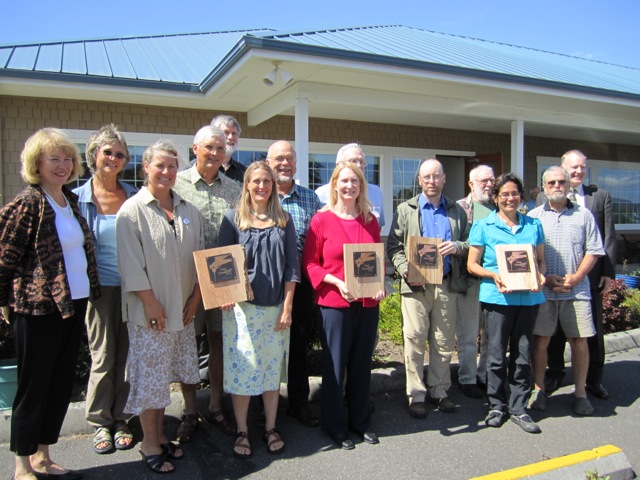
How fitting it is, then, to have the corruption-haunted PSP recognize these same people as "Puget Sound Champions." And Linda Lyshall (remember, she was copied on the emails about secret meetings) is kind enough to announce the awards via email. In the photo below, Buffum, Whitman, and Rosenkotter are standing just behind two of the four plaques (the two plaques on the left).
They're champions alright — champions in the same vein as Lance Armstrong.
_________________________________________

The money dealings involving Norm Dicks and the PSP were so shady that the organization Citizens for Responsibility and Ethics in Washington (CREW) gave Dicks "dishonorable mention" as one of the most corrupt members of Congress earlier this year.
Over the last few posts, we've seen Stephanie Buffum, Tina Whitman, Barbara Rosenkotter, and others conspire with one another about public meetings or plan secret meetings to altogether avoid public scrutiny of public information. We've seen them create and defend pathetically bad data which falsely incriminates and hectors innocent landowners.
How fitting it is, then, to have the corruption-haunted PSP recognize these same people as "Puget Sound Champions." And Linda Lyshall (remember, she was copied on the emails about secret meetings) is kind enough to announce the awards via email. In the photo below, Buffum, Whitman, and Rosenkotter are standing just behind two of the four plaques (the two plaques on the left).
They're champions alright — champions in the same vein as Lance Armstrong.
_________________________________________
From: Linda Lyshall <lindal@sanjuanco.com>Subject: FW: San Juan Champions PhotoDate: August 23, 2012 8:53:36 AM PDTTo: Linda Lyshall <lindal@sanjuanco.com>
Dear IC and AOC,I’ve attached a photo of the San Juan Puget Sound Champion award winners. Congratulations to the members of our Implementation Committee: Stephanie Buffum, Alan Chapman, Kit Rawson, and Barbara Rosenkotter, for well-deserved recognition. Tony Wright and Diana Gale from the Puget Sound Partnership gave out the awards yesterday at our San Juan LIO meeting.Linda
Sunday, November 4, 2012
Thanks, But We Believe The Friends More Than You!
Suppose you come from an old island family, and you've lived on your property for decades. You have photos of your beach going back 100+ years.
Want to guess what all the fuss is about? I'm sure you've seen old piles of field stones that dot the pastures in these islands. Settlers used to pile rocks during land clearing to make the land easier to work. Many of these piles can still be seen around the county. It just so happens that in the case described above, an old pile of field stone was placed on the upper part of a beach instead of in a field. Roll forward about 100 years or so and along come the Friends, and they map the old rock pile as a "shoreline modification" ... a pile of field stone that's probably over a century old ... and is in rather shabby condition to boot.
See for yourself. The homeowners are in disbelief (as is the Trojan Heron).
____________________________________________________________


Now suppose that the County identifies "shoreline armoring" on your beach, which the County characterizes as a potential ecological hazard to fish. The trouble is that you don't have any shoreline armoring on your beach, and you don't know what the County is talking about.
So you write to the County to try to set matters straight, but the reply you receive from the County essentially says, "Sorry, but the Friends have mapped shoreline armoring on your property, and I really can't correct the data now that it's in the database."
Thank you for your comments and pictures. The County was not involved in collecting the shoreline modification data used in the Inventory and Characterization Report shoreline modification maps. The dataset was collected by the Friends of the San Juan’s and subsequently passed along to the Department of Ecology to be used in the Washington Coastal Atlas.Well, thank you very much indeed! We (the County) believe Tina Whitman and not you, but thanks all the same. We think your homeowner information stretching back decades is anecdotal, but the Friends information is science.
Many of the datasets used in the Inventory and Characterization Report were developed by organizations other than the County, including the National Marine Fisheries, National Oceanic and Atmospheric Administration, Native Tribes, Department of Ecology and others.
In order to be consistent with the state law, the County collected available information for inclusion in the Inventory and Characterization Report. That said, the County is not precluded from considering anecdotal evidence and your letters and pictures are part of the record that the Planning Commission and Council will consider when evaluating the merits of the updated Shoreline Master Program.
I relayed your concerns to the data providers and they have reaffirmed their original finding. I’ve attached a copy of an email I received from Tina Whitman of the Friends of the San Juan’s. Ms. Whitman, I understand played an active role in the collection of the data.
Without a site visit, I cannot determine the accuracy of this data point.
Please submit your comments to colinm@sanjuanco.com or to the mailing address above.
Thank you for your time and commitment to SMP update process.
Want to guess what all the fuss is about? I'm sure you've seen old piles of field stones that dot the pastures in these islands. Settlers used to pile rocks during land clearing to make the land easier to work. Many of these piles can still be seen around the county. It just so happens that in the case described above, an old pile of field stone was placed on the upper part of a beach instead of in a field. Roll forward about 100 years or so and along come the Friends, and they map the old rock pile as a "shoreline modification" ... a pile of field stone that's probably over a century old ... and is in rather shabby condition to boot.
See for yourself. The homeowners are in disbelief (as is the Trojan Heron).
____________________________________________________________
From: Tina Whitman [mailto:tina@sanjuans.org]
Sent: Thursday, September 06, 2012 3:28 PM
To: Colin Maycock
Cc: Stephanie Buffum
Subject: modification inventory question
Sent: Thursday, September 06, 2012 3:28 PM
To: Colin Maycock
Cc: Stephanie Buffum
Subject: modification inventory question
Hi Colin,
Per your request I reviewed the tax parcel number you sent me in our 2009 shoreline modification inventory ARC GIS geodatabase.
The attached document shows:
Pg. 1) tax parcel (red dot), armor line from modification inventory (red line), as well as the location of the two photos (black dot and purple triangle);
Pg. 2) the county’s vertical aerial photographs from 2008 with the rockery in question circled in red; and
Pgs. 3) and 4) the two project photos taken at the time of the boat based survey, in June of 2009.
Our project mapped all shoreline armoring (hardening) greater than 5 feet in shoreline length. The rock fill at the base of and along that section of bank met that criteria and as a result were mapped. I don’t know if it has been since been removed, or if it’s a difference of opinion regarding more typical ‘bulkheads’ (the definitions of which vary widely depending on your discipline and region of the country and world) versus ‘armoring’, but the photos indicate the presence of placed rock in 2008 (san juan county’s vertical aerials) and 2009 (modification inventory field photos).
Regards,
Tina
Tina Whitman, MS
Science Director
Friends of the San Juans
P.O. Box 1344 Friday Harbor, WA 98250
(360) 378-2319 www.sanjuans.org


What's a Puppet Master to Do?
Stephanie Buffum is learning that the life of puppet master isn't the life of leisure that it's cracked up to be ... what with all the County employees needing constant TLC to advance the Friends agenda from the inside. It's work rigging public meetings.
Below is yet another email between Stephanie Buffum of the Friends and Barbara Rosenkotter, Salmon Recovery Lead for our County. Recall that Buffum and Rosenkotter have a special relationship (aka Stephanie Rosenkotter), even sharing rants where they liken themselves to Ghandi, Rosa Parks, and MLK.
In the email below, Buffum is informing Rosenkotter of her selection to run an upcoming County SMP meeting (now make it so Barbara). Buffum's preferred speaker is unavailable, so she is resigned to the inevitability of having to make do with Colin Maycock who is, after all, on "our team" as Buffum puts it. Remember, Colin Maycock is nominally in charge of the County SMP update, but it doesn't seem like he's de facto in charge from the looks of this email.
Why don't we stop pretending and just include the Friends on the County organizational chart as the County Department of Natural Resources, which has been an ambition of Stephanie Buffum's for years anyway. The Friends already have a more direct line of authority to some staff than either the Council or the Administrator.
Note: We don't know who "Tim" and "Bob" are referring to in the email below, but we suspect Bob Fritzen of Ecology. There are several possibilities for Tim, including Tim Beechie of NOAA, Tim Strickler of the PSP, or Tim Quinn of WDFW/PSP ... maybe even Tim Hyatt of the Skagit River Cooperative or Tim Trohimovich of Futurewise ... or Tim Gates of the Washington Department of Commerce. But we admit that we don't know, but maybe one of you does.
Below is yet another email between Stephanie Buffum of the Friends and Barbara Rosenkotter, Salmon Recovery Lead for our County. Recall that Buffum and Rosenkotter have a special relationship (aka Stephanie Rosenkotter), even sharing rants where they liken themselves to Ghandi, Rosa Parks, and MLK.
In the email below, Buffum is informing Rosenkotter of her selection to run an upcoming County SMP meeting (now make it so Barbara). Buffum's preferred speaker is unavailable, so she is resigned to the inevitability of having to make do with Colin Maycock who is, after all, on "our team" as Buffum puts it. Remember, Colin Maycock is nominally in charge of the County SMP update, but it doesn't seem like he's de facto in charge from the looks of this email.
Why don't we stop pretending and just include the Friends on the County organizational chart as the County Department of Natural Resources, which has been an ambition of Stephanie Buffum's for years anyway. The Friends already have a more direct line of authority to some staff than either the Council or the Administrator.
Note: We don't know who "Tim" and "Bob" are referring to in the email below, but we suspect Bob Fritzen of Ecology. There are several possibilities for Tim, including Tim Beechie of NOAA, Tim Strickler of the PSP, or Tim Quinn of WDFW/PSP ... maybe even Tim Hyatt of the Skagit River Cooperative or Tim Trohimovich of Futurewise ... or Tim Gates of the Washington Department of Commerce. But we admit that we don't know, but maybe one of you does.
From: Stephanie Buffum [mailto:stephanie@sanjuans.org]
Sent: Friday, January 28, 2011 1:29 PM
To: Barbara Rosenkotter
Subject: Feb 24 - SMP speaker
Sent: Friday, January 28, 2011 1:29 PM
To: Barbara Rosenkotter
Subject: Feb 24 - SMP speaker
Hi Barbara,
I spoke with Tim in detail on Wed. He is sympathetic and overwhelmed with his new position which now also includes Watershed Lead for Thurston County.
After much discussion, we determined that Colin would be the best person, with Bob being back up in the back of the room. I saw Colin’s most recent SMP presentation to the county council and with some minor tweaks to make it fit 15 minutes I am confident that it would be fine. Especially if Bob is in the room as back up for questions. Since this is only an SMP appetizer I think this will work fine with our limited timeline. Tim was going to be talking with Colin yesterday at the SMP coordination meeting for planners in Olympia. I asked if he would provide some extra tlc to Colin. He may not be Tim, but he’s on our team and we need to do what we can to make the most out of his skill set. I would be happy to meet with him and refine his presentation with him. He’s going to have to improve his public speaking and there’s no time like the present.
So, it seems like it may make the most sense for you to approach Colin and Bob. I am getting prepared for our BIG meeting on Monday and a bit stressed for time this next week.
I look forward to meeting on Monday 2/14 at your office to refine the agenda.
Stephanie Buffum Field
FRIENDS OF THE SAN JUANS
Executive Director
360. 378.2319 office
360.472.0404 cell
Subscribe to:
Posts (Atom)